Quick Answer: Performance marketing is paid advertising where you pay for measurable results, such as clicks, leads or sales, and judge every campaign by numbers like CPA and ROAS. A performance marketing course teaches Meta Ads, Google Ads, tracking and analytics. In India, courses cost roughly ₹25,000 to ₹1.5 lakh, and you can start practising for far less.
Picture two shop owners. Both spend ₹10,000 on Meta ads in a month. Both get about 40 orders. One of them is growing. The other is quietly losing money.
What separates them has little to do with luck or a better-looking ad. One of them understood the numbers behind the campaign, and the other didn't. Teaching you those numbers is the whole point of a performance marketing course, and it's a big reason paid-ads skills are in demand.
This guide explains what performance marketing is, which numbers matter, what a good course covers, what courses cost in India, and how to start without wasting money. I'm Abhishek Gupta, founder of Social Baniya Academy in Hisar. Our agency runs paid campaigns for clients, and I'll mention our own course near the end, clearly marked.
What Is Performance Marketing?
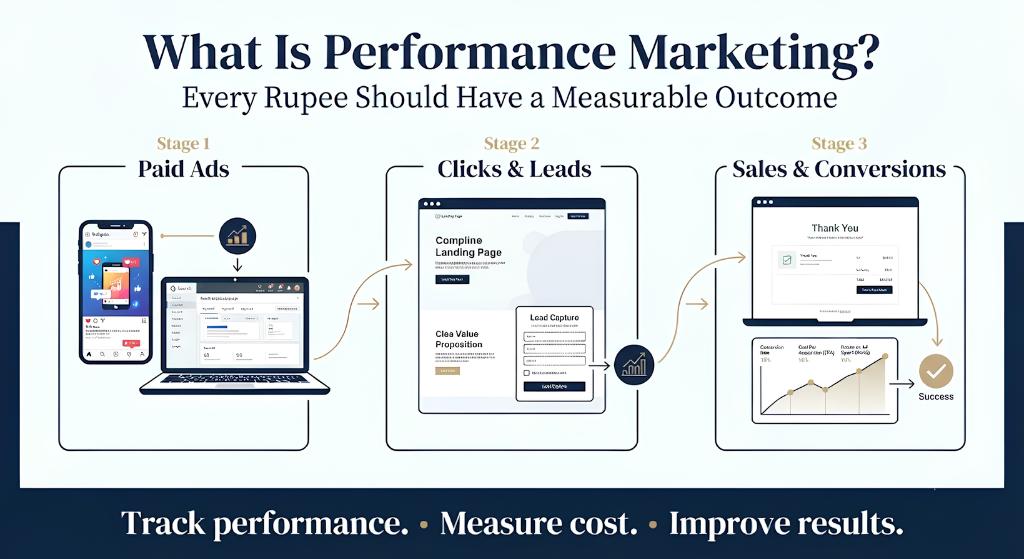
Performance marketing is a way of advertising where every rupee is tied to a result you can measure. You don't pay for "reach" or "brand awareness" and hope for the best. You pay for clicks, leads, app installs or sales, and you track exactly what each one cost.
The main channels are Meta Ads (Facebook and Instagram), Google Ads (Search, YouTube, Shopping and Performance Max), and sometimes marketplaces or affiliate networks. What ties them together is the dashboard. If a campaign can't be measured, it isn't performance marketing.
Performance Marketing vs Digital Marketing
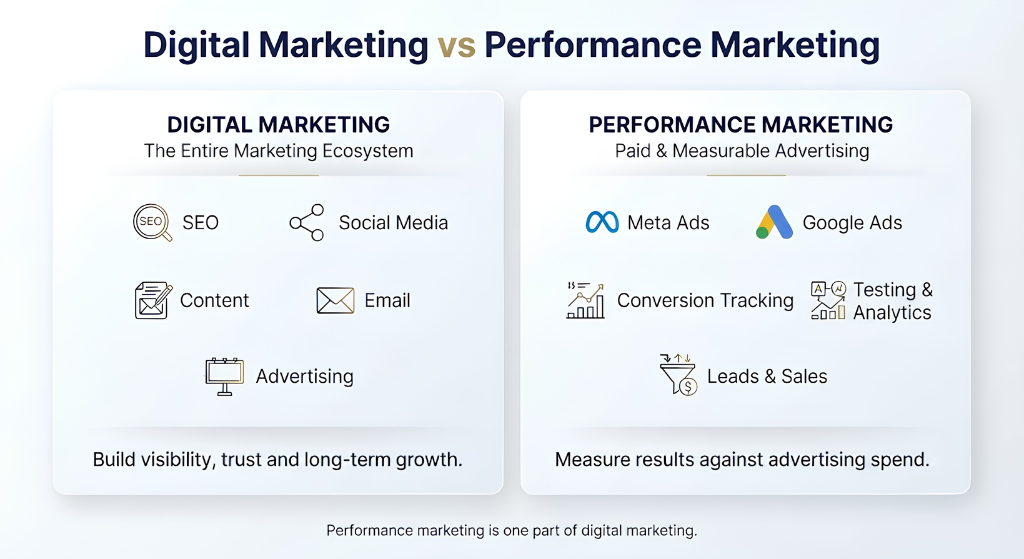
Performance marketing is one part of digital marketing, not a rival to it. Digital marketing is the whole toolbox: SEO, social media, email, content and ads. Performance marketing is the paid, measurable slice of it.
| Digital Marketing (overall) | Performance Marketing | |
|---|---|---|
| Scope | SEO, social media, content, email, ads | Paid ads on Meta, Google and similar platforms |
| Goal | Visibility, trust and leads over time | Measurable leads or sales you can trace to spend |
| Speed of results | Slower (SEO and content compound) | Faster, but stops when the budget stops |
| Key skill | Strategy across channels | Tracking, testing and reading numbers |
| Typical first job | Executive or social media role | Ads executive or campaign analyst |
My view: learn digital marketing basics first, then specialise. Someone who understands SEO and funnels makes better ad decisions than someone who only knows how to click "boost post." If you're still deciding where to begin, our guide on the digital marketing course after 12th maps out the starting paths.
The Numbers That Decide Everything
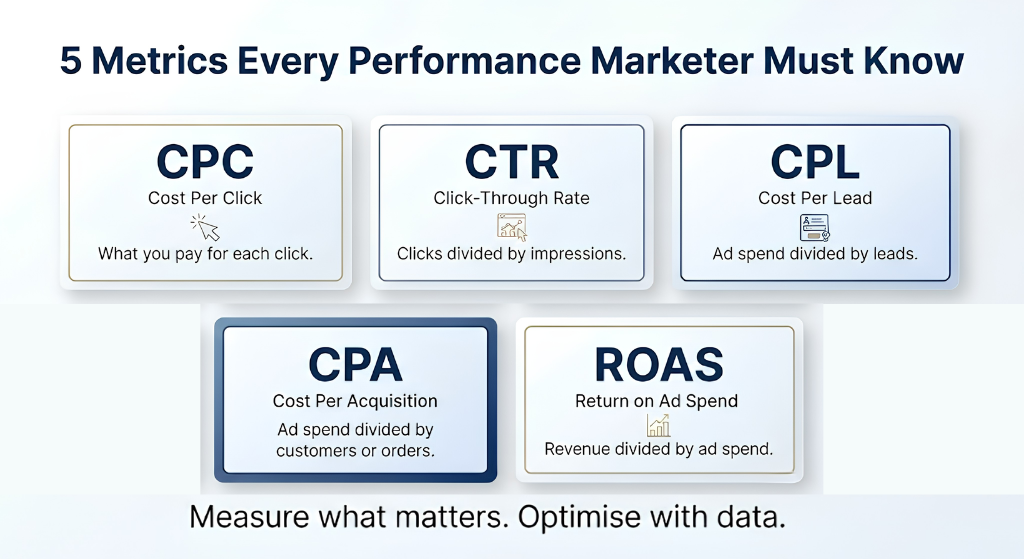
Performance marketers talk in a handful of metrics. You'll use these every week.
| Metric | What it means | Why it matters |
|---|---|---|
| CPC (cost per click) | What you pay for each click | Shows how expensive your traffic is |
| CTR (click-through rate) | Clicks divided by impressions | Tells you if your ad catches attention |
| CPL (cost per lead) | Spend divided by leads | Key for coaching, real estate and services |
| CPA (cost per acquisition) | Spend divided by customers or orders | What it really costs to win a customer |
| ROAS (return on ad spend) | Revenue divided by ad spend | Shows how much sales each ₹1 of ads brings |
A worked example (illustrative numbers, not a real client)
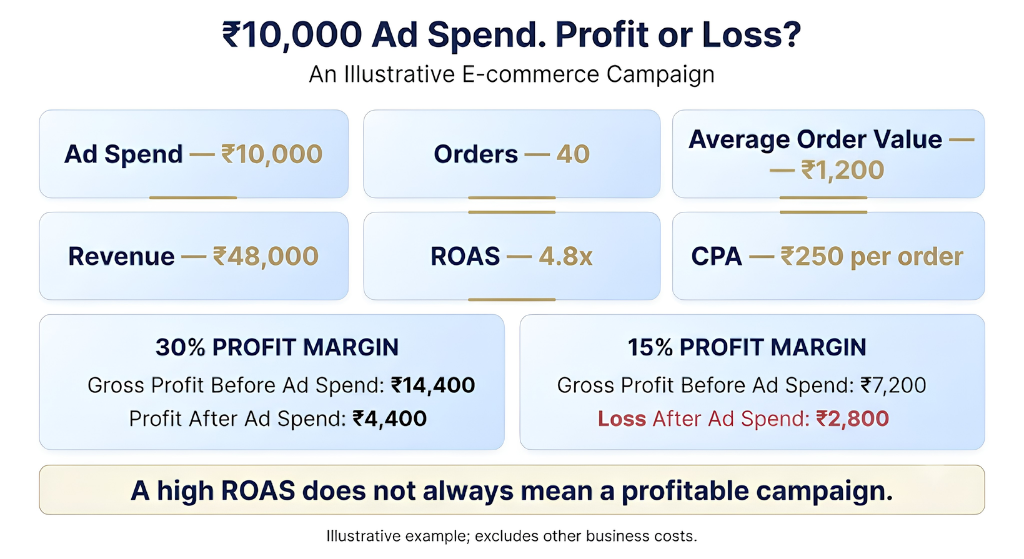
Go back to our two shop owners. Say a Hisar clothing shop spends ₹10,000 on ads and gets 40 orders at an average of ₹1,200 each.
- Revenue: 40 × ₹1,200 = ₹48,000
- ROAS: ₹48,000 ÷ ₹10,000 = 4.8
- CPA: ₹10,000 ÷ 40 = ₹250 per order
A ROAS of 4.8 sounds excellent. But now bring in profit margin. If the shop earns a 30% margin on each sale, it keeps ₹14,400 from ₹48,000. After the ₹10,000 ad spend, that's ₹4,400 profit. Fine. But if the margin were only 15%, the shop would keep ₹7,200 and lose ₹2,800 on the campaign, even with the same "great" ROAS.
This is the part many beginners miss. The break-even ROAS is 1 divided by your margin. At 30% margin it's 3.3. At 15% it's 6.7. A ROAS number means nothing until you compare it with the margin. A good course makes you do this math until it's automatic.
What a Good Performance Marketing Course Should Cover
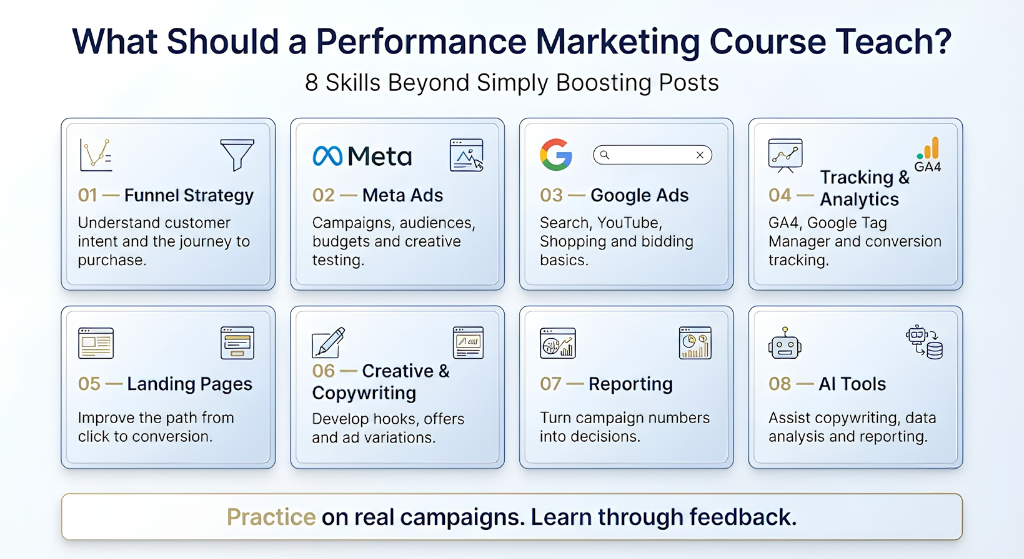
- Funnel and customer thinking. Who is buying, what do they worry about, and what happens between the ad and the sale?
- Meta Ads. Campaign structure, audiences, creatives, budgets and testing.
- Google Ads. Search, YouTube, Shopping and Performance Max, with keyword and bidding basics.
- Tracking and analytics. Google Analytics 4, Google Tag Manager and conversion tracking, plus reading Meta Ads Manager and Google Ads reports. If tracking is wrong, every decision after it is wrong.
- Landing pages and conversion. Why a good ad still fails on a weak page.
- Creative and copywriting. Hooks, offers and testing ad variations.
- Reporting. Turning numbers into clear decisions for a client or boss.
- AI tools. Using AI to draft copy, analyse data and speed up reporting, while you still make the decisions.
Most important: you should run campaigns in a real ad account, with real money, and get feedback. Watching someone else's screen recording isn't the same. Our syllabus guide shows how these topics fit into a full curriculum.
A Real Example: Sneaker Studio's ROAS Went From 4x to About 20x
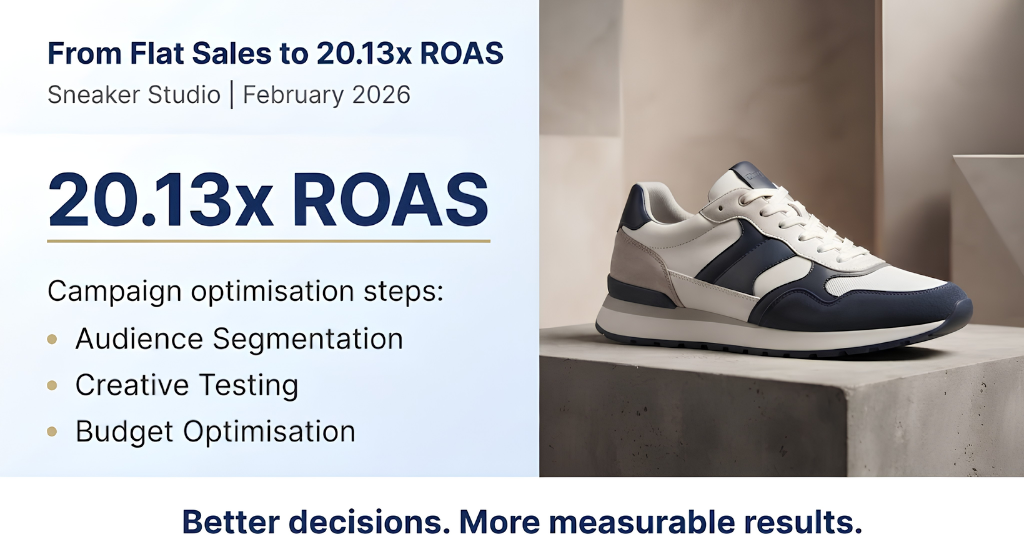
Sneaker Studio is a D2C men's footwear brand that runs Meta Ads with our team on a budget of about ₹1,00,000 a month. It needed to scale sales profitably while its customer acquisition cost was rising and few catalogue products were getting seen.
We rebuilt the account as a full funnel: catalogue sales campaigns with dynamic product ads, cold prospecting, warm engagement, cart-abandonment retargeting, and a creative refresh every two weeks to fight ad fatigue. ROAS moved from about 4x to about 20x, and cost per purchase fell from ₹650 to ₹100, as shown in the live campaign data of our case study.
Look at what drove the result. No secret setting was involved. The gains came from decisions about who to target, what to show them and how closely to tie spend to results. Those decisions are the real skill a course should build.
Performance Marketing Course Fees in India
Fees vary widely, and many institutes don't publish them. The table below shows figures listed in IIM Skills' 2026 guide. This is a third-party summary and prices change, so confirm with each provider.
| Provider | Published Fee |
|---|---|
| IIM Skills | ₹24,900 (excluding taxes) |
| NIDE | ₹30,000 |
| WsCube Tech | ₹34,999 (including taxes) |
| Kandra Digital | ₹50,000 to ₹1,50,000 (three programmes) |
| The Knowledge Academy | From ₹1,54,995 |
| Udemy-style self-paced courses | About ₹500 a month or ₹2,400 per course |
Two things stand out. First, a higher fee doesn't automatically mean more practice. Second, several providers don't publish a price at all, so you only learn it after a sales call. Ask for the total fee, taxes, EMI terms and refund policy in writing before you commit. We break this down further in our digital marketing course fees guide.
Careers and Salary in Performance Marketing
Published figures differ, so treat them as ranges, not promises. IIM Skills' guide lists early-career pay at about ₹3 to ₹5 lakh a year and mid-to-senior roles at ₹6 to ₹9 lakh. It also cites Glassdoor for a typical Performance Marketing Manager salary of around ₹12.25 lakh, with a small number of senior D2C roles paying far more. Pay in a Tier-2 city like Hisar often starts lower than in metros, unless you work remotely for a brand elsewhere.
Common roles include:
- Performance Marketing Executive or Analyst
- Meta Ads or Google Ads Specialist
- Growth Marketer (D2C and e-commerce brands)
- Freelance ads manager for local businesses
- In-house marketer at a shop, clinic, coaching centre or real estate firm
For freelancers, the opportunity is local. Many businesses in cities like Hisar run ads without anyone tracking results properly. A person who can set up tracking and show a clear before and after has a real edge.
How to Start in 60 Days Without Wasting Money
- Days 1 to 15: learn the vocabulary. Work through the free training on Meta Blueprint and Google Skillshop. Understand CPC, CTR, CPA and ROAS, and practise the break-even math above with five made-up businesses.
- Days 16 to 30: learn tracking. Set up Google Analytics 4 on a simple website you control. Learn what a conversion is and how to record one.
- Days 31 to 50: run one small real campaign. My suggestion is a test budget of ₹3,000 to ₹10,000 for a real local business, with the owner's permission. Change one thing at a time and write down what happened.
- Days 51 to 60: write it up. Make a one-page case study: goal, what you tried, numbers before and after, what you'd do next. Even a modest result with honest numbers is worth more than a certificate on its own.
If you finish this and you're excited rather than exhausted, a structured course will be much more valuable to you, because you'll ask better questions.
7 Common Beginner Mistakes in Paid Ads
- Spending before tracking works. If conversions aren't recorded, you're guessing.
- Judging by likes and reach. Neither pays the rent.
- Celebrating ROAS without checking margin. See the example above.
- Changing everything at once. You'll never learn what worked.
- Scaling too fast. Doubling a budget overnight can break a campaign that was working.
- Ignoring the landing page. A great ad can't rescue a confusing page.
- Copying competitors' ads. Their audience, margin and offer aren't yours.
How to Choose a Performance Marketing Course
- Will I run campaigns in a real ad account with real budgets?
- Is the trainer handling live paid campaigns right now?
- Does the course teach tracking and margin math, or only how to click through ad platforms?
- Are the fees, syllabus and refund policy in writing?
- Can I attend a demo class and speak to a past student?
Red flags: "India's #1 course" claims with no source, placement percentages you can't verify, and guarantees about salary or ROAS. No honest trainer can promise you a result. Ads depend on the product, the market and your own testing.
Learning Paid Ads With Social Baniya Academy
To be clear about what we offer: Social Baniya Academy doesn’t run a full performance marketing programme. We have two options that cover the paid-ads side. Social Baniya — Meta Ads Mastery | Live Cohort by Abhishek Gupta is a live cohort focused only on Meta Ads (₹4,999 online, ₹7,999 offline in Hisar, as published on its page). Our 90-day AI-integrated digital marketing course also includes Meta Ads, Google Ads, Google Analytics and lead generation, alongside SEO, AI tools and WordPress. It has 6 main modules with 16 sub-topics, is built from campaigns our agency runs, and runs offline in Hisar or as a flexible online batch.
About the Author: Abhishek Gupta
Abhishek Gupta is the founder of Social Baniya Academy (Hisar, Haryana) and runs Meta Ads and Google Ads campaigns for D2C and local businesses through the Social Baniya agency. In class, he shows live campaign work directly. Last reviewed: October 2026.
Frequently Asked Questions
1. What is performance marketing?
Performance marketing is paid advertising where you pay for measurable results, such as clicks, leads or sales. Every campaign is judged by numbers like cost per acquisition (CPA) and return on ad spend (ROAS). It mainly uses platforms like Meta Ads and Google Ads.
2. What is the difference between performance marketing and digital marketing?
Digital marketing is the whole field: SEO, social media, content, email and ads. Performance marketing is the paid, measurable part of it. Digital marketing builds visibility over time, while performance marketing aims for traceable leads or sales from ad spend.
3. How much does a performance marketing course cost in India?
Published fees start at about ₹2,400 for self-paced online courses, run between ₹24,900 and ₹35,000 for typical institute programmes, and reach ₹1.5 lakh or more for premium ones. Always get the total fee, taxes and refund policy in writing.
4. What is a good ROAS?
There is no single good ROAS. It depends on your profit margin. Break-even ROAS equals 1 divided by your margin, so a 30% margin breaks even near 3.3, and a 15% margin near 6.7. Anything above break-even is profit before other costs.
5. Is performance marketing a good career?
It can be, because businesses pay for people who can turn ad spend into measurable results. Published salaries range from about ₹3 to ₹5 lakh for early careers to ₹12 lakh or more for managers. Your pay depends on skill, portfolio and the market, not on a certificate alone.
6. Do I need maths or coding for performance marketing?
You need school-level maths: percentages, ratios and simple margins. You don't need coding. Setting up tracking sometimes involves copying code snippets, but tools and tutorials make this manageable for beginners.
7. Can I learn performance marketing without a course?
Yes, partly. Free platform training and a small real campaign can teach a lot. A course helps most when it gives structured feedback, covers tracking and analytics, and makes you practise on real campaigns. Start small, then decide.
Sources and How This Guide Was Made
Fee and salary figures come from IIM Skills' 2026 guide to performance marketing courses, which is a third-party summary, so confirm prices with each provider. The worked example uses illustrative numbers, not a real client. The Sneaker Studio result is from our own agency work. We checked the arithmetic in the examples, and we haven't verified any provider's claims about placement or outcomes.
Your Next Step
Remember our two shop owners? Pick any business you know, a shop, a clinic, a coaching centre, and work out its break-even ROAS: 1 divided by its profit margin. If that little exercise made you curious rather than bored, you're ready for the next step. If you'd like to see how we teach paid ads inside our digital marketing course, book a free demo class. No commitment, just a class and your questions.